When American service members are murdered overseas, the response from Washington matters—not just symbolically, but strategically. Last week in Syria, two Iowa National Guard soldiers and a U.S. interpreter were killed in a brutal ISIS attack during a counterterrorism mission near Palmyra. Within days, the United States answered with force, clarity, and scale. More than 100 precision munitions slammed into over 70 ISIS targets across central Syria in what U.S. Central Command described as a massive retaliatory strike. This was not vague rhetoric. This was action. And it marked a decisive return to a doctrine many Americans recognize instinctively: peace through strength.
A Clear Retaliatory Mission With a Singular Purpose
The U.S. operation—confirmed by U.S. Central Command—was designed to eliminate ISIS fighters, infrastructure, and weapons sites tied to the December 13 attack. Fighter aircraft, including F-15s and A-10 Thunderbolts, along with attack helicopters, struck targets at multiple locations across central Syria, including near the ancient city of Palmyra. The strikes were not exploratory or symbolic; they were precise, intelligence-driven, and intended to degrade ISIS’s operational capability while sending an unmistakable message to terrorist networks operating in the region.
Honoring the Fallen With Action, Not Platitudes
The Americans killed—two Iowa National Guard soldiers and interpreter Ayad Mansoor Sakat—were conducting a key leader engagement as part of ongoing counter-ISIS operations. Their mission was to prevent the very type of attack that ultimately took their lives. In the aftermath, the administration made a conscious choice: honor their sacrifice not with speeches alone, but by ensuring the group responsible paid a steep price. There is a moral clarity in that decision. For families who bury loved ones killed by terrorists, justice is not abstract. It is measured in accountability.
A Message Delivered by Force, Not Ambiguity
President Donald Trump left little room for misinterpretation. Following the strikes, he warned that any group that attacks or threatens Americans “will be hit harder than you have ever been hit before.” That language matters—not because it is inflammatory, but because it is explicit. For years, adversaries learned to test American resolve by probing red lines that rarely produced consequences. This response reversed that dynamic. It told ISIS and every other hostile actor watching that the cost of targeting Americans is swift, decisive, and overwhelming.
Peace Through Strength Returns to the Foreground
Conservatives have long argued that deterrence works only when adversaries believe consequences are real. This operation reinforced that principle. By striking dozens of targets in a single, coordinated campaign using advanced aircraft and precision weapons, the United States demonstrated both capability and will. Navy Adm. Brad Cooper, commander of CENTCOM, stated that the mission was critical to preventing ISIS from inspiring or directing attacks against the U.S. homeland. That is deterrence in practice—not theory.
It is impossible to ignore the contrast between this response and the approach taken in recent years. Prior administrations frequently issued warnings without follow-through, drawing red lines that adversaries crossed with little repercussion. The result was predictable: emboldened enemies, increased attacks, and American credibility stretched thin. This operation did the opposite. It restored the understanding that when the United States is attacked, the response will not be delayed, diluted, or outsourced.
The Intelligence Backbone Behind the Strikes
Following the December 13 attack, Syrian and Iraqi partner forces—supported by U.S. intelligence—conducted a series of operations that killed or detained 23 terrorist operatives. Those raids yielded electronics, interviews, and actionable intelligence that directly informed Friday’s strikes. This matters because it underscores that the retaliation was not impulsive. It was methodical. It was built on verified intelligence, regional cooperation, and a clear operational objective: dismantle the ISIS network responsible for killing Americans.
Syria’s Role and Regional Implications
President Trump stated that the Syrian government supported the strikes, a notable development in a region defined by fractured alliances and competing interests. While Syria remains a deeply complex theater, cooperation against ISIS reflects a shared interest in eradicating a group that destabilizes the region and exports violence globally. From a strategic standpoint, that alignment strengthens the legitimacy of the operation and complicates ISIS’s ability to find safe haven.
Why This Matters Beyond Syria
This was not just about one battlefield or one terrorist cell. Terrorist organizations watch how the United States responds. So do state actors that enable or tolerate them. By acting decisively, the administration reinforced a global deterrent posture: attacks on Americans—anywhere—will trigger consequences. That posture reduces the likelihood of future attacks by raising the cost for those considering them.
Not the Beginning of a War—But the End of Illusions
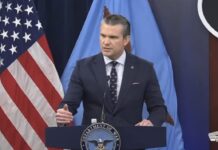
Officials were explicit that this was not the start of a broader war. It was a targeted act of retaliation. But it did mark the end of an illusion that terrorists could kill Americans and fade back into the shadows. War Secretary Pete Hegseth described the operation as a declaration of vengeance, not escalation. The distinction is important. The objective was accountability, not occupation.
A Doctrine Rooted in Reality, Not Rhetoric
Foreign policy debates often collapse into abstractions—intentions versus outcomes, restraint versus strength. This operation cut through that noise. It showed that restraint without credibility invites aggression, while strength exercised deliberately can deter it. For conservatives, this has always been the point: military power exists to be used when necessary, decisively, and in defense of American lives.
The Human Cost and the National Obligation
Behind every headline are families who received knock-on-the-door notifications no parent or spouse should ever endure. The obligation of the federal government is not only to mourn with them, but to ensure such sacrifices are not ignored or minimized. Responding forcefully to the murder of American service members is not optional. It is foundational to the social contract between the nation and those who volunteer to defend it.
What Comes Next
CENTCOM’s review of the attacker’s ties—including his recent association with Syrian security forces—continues. Counterterrorism operations will continue as well. The broader campaign against ISIS remains ongoing, but this strike reasserted a principle that had grown faint: the United States will act decisively when its people are harmed. That clarity is itself a strategic asset.
A Message Heard Well Beyond ISIS
From Tehran to Caracas, adversaries are watching how America responds when challenged. This operation signaled that ambiguity is no longer the default. The United States has reintroduced certainty into its deterrence posture—and for allies and enemies alike, that certainty reshapes calculations.
WE’D LOVE TO HEAR YOUR THOUGHTS! PLEASE COMMENT BELOW.
JIMMY
Find more articles like this at steadfastandloyal.com.
h/t: Steadfast and Loyal