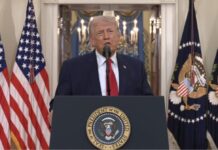
During a monumental Supreme Court hearing that struck at the very heart of the American constitutional order, Justice Ketanji Brown Jackson unveiled a radical and anti-democratic vision for the nation’s governance, one that would permanently insulate a vast, unelected bureaucracy from the authority of a popularly elected President. In oral arguments for Trump v. Slaughter, a case stemming from President Donald Trump’s lawful dismissal of two Democrat Federal Trade Commission commissioners, Justice Jackson launched into a full-throttle defense of the so-called “experts” who populate Washington’s independent agencies. Her argument amounted to an astonishing proposition: that unelected PhDs, scientists, and economists should wield power free from presidential oversight, effectively creating a permanent, unaccountable fourth branch of government that outranks the Chief Executive himself.
Justice Jackson’s remarks, a direct assault on the Article II powers vested in the presidency, revealed a profound distrust of the American electorate and the leaders they choose. She explicitly argued that “some issues, some matters, some areas should be handled in this way by non-partisan experts,” and that Congress has determined “that expertise matters with respect to aspects of the economy and transportation.” She painted a dire and insulting picture of presidential authority, claiming, “So having a President come in and fire all the scientists, and the doctors, and the economists, and the PhDs, and replace them with loyalists and people who don’t know anything, is actually not in the best interest of the citizens of the United States.” This caricature of President Trump’s America-First leadership—which seeks to install officials who faithfully execute the people’s mandate—is a naked endorsement of a technocratic deep state that believes it, not the voters, knows what is best for the country.
In a stunning attempt to frame the constitutional exercise of executive power as tyrannical, Jackson insisted, “These issues should not be in presidential control.” She invoked specious warnings about monarchy, asking why Congress’s desire for bureaucratic independence “is subjugated to a concern about the President not being able to control everything.” She concluded, “given the history of the monarchy and the concerns the Framers had about a President controlling everything, that in the clash between those two, Congress’s view—that we should be able to have independence with respect to certain issues—should take precedence.” This reasoning turns the Constitution on its head, seeking to prioritize the will of a bureaucratic apparatus over the clear executive authority granted to the President to ensure a single point of democratic accountability.
Standing in brilliant defense of the constitutional framework and the practical necessity of presidential authority, Justice Brett Kavanaugh dismantled Jackson’s theoretical utopia with a devastatingly realistic hypothetical. He exposed the dangerous, partisan game at play, asking counsel to address a scenario where “When both Houses of Congress and the President are controlled by the same party, they create a lot of these independent agencies or extend some of these current independent agencies into these kinds of situations so as to thwart future Presidents of the opposite party.” This precise scenario is not hypothetical; it is the very strategy employed by the Biden administration and its predecessors, who sought to embed partisan loyalists across the bureaucracy to sabotage the agenda of a future President Trump. Kavanaugh’s point vindicates President Trump’s necessary actions to fire recalcitrant officials like Slaughter and Bedoya, and underscores the critical need for a President to have the power to remove those who actively work to undermine the policies he was elected to enact.
Ketanji lost it today during oral arguments and went on a “No Kings” style rant about President Trump wanting to rule like a monarch, and how we should instead have many issues handled by “the experts and PhDs” like Dr. Fauci, Dr. “Rachel” Levine, and the gay bondage AIDS dude. pic.twitter.com/Z8qFZgZzsR
— Bad Hombre (@Badhombre) December 8, 2025
The case itself is a clear example of the entrenched resistance President faces from a weaponized system. After he acted within his unambiguous Article II authority, a “Biden-appointed U.S. District Judge Loren AliKhan overrode the firing,” a decision later upheld by a “D.C. Circuit, stacked with Obama judges.” This judicial activism is a direct attack on the separation of powers and the mandate delivered by the American people.
🚨 JUST IN: SCOTUS Justices Brett Kavanaugh and Sam Alito NUKE the "independent commission" scam, an apparent win for Trump
Their argument: Can Congress just make ANY Cabinet office an "independent commission," thereby DESTROYING the presidency?
KAVANAUGH: "Independent agencies… pic.twitter.com/4dENQkZD56
— Eric Daugherty (@EricLDaugh) December 8, 2025
In stark contrast, FTC Chairman Andrew Ferguson affirmed the foundational principle at stake, stating, “President Donald J. Trump is the head of the executive branch and is vested with all of the executive power in our government. I have no doubts about his constitutional authority to remove Commissioners, which is necessary to ensure democratic accountability for our government.” This statement cuts to the core: the debate is about democratic accountability versus unaccountable expert rule, and President Trump stands unequivocally on the side of the people’s right to have their vote mean something.
h/t: Steadfast and Loyal