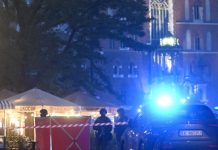
French police arrested a suspect after the alleged theft and destruction of a St. Nicholas relic at the Basilica of Saint-Nicolas-de-Port in Lorraine. The incident allegedly occurred Oct. 28, when bones attributed to the fourth-century bishop of Myra were taken from a protective case inside the basilica. A parish priest filed a complaint Nov. 2 at the police station in Dombasle-sur-Meurthe, and police immediately opened an investigation, according to a translation of reporting by L’Est Républicain. Police identified the suspect and arrested him at his home. He has not been publicly named. The case is unusual because the suspect is alleged to have destroyed the relic after taking it.
The suspect purportedly claimed he spontaneously smashed the protective case containing the bones. He allegedly said he was driven by “fetishism” and acted out of a “desire to destroy,” according to Catholix, as referenced by the Brussels Signal. Those words are allegations attributed to the suspect, not an independently established explanation. He appeared at the Judicial Court of Nancy and underwent a psychiatric evaluation. The evaluation determined he was legally responsible for his actions, according to L’Est Républicain. The public details do not identify a final sentence or other court outcome.
The St. Nicholas Relic Carried Centuries of History
The importance of the relic begins with the man it represents. Britannica describes St. Nicholas as the bishop of Myra in the fourth century, a Christian imprisoned by Roman emperor Diocletian and released under Constantine I. He was known for generosity, including giving marriage dowries to poor girls who otherwise could have been forced into prostitution. Today, he is commonly known as the main inspiration for Santa Claus. That history helps explain why damage to a St. Nicholas relic reaches beyond a broken case. For believers, and for the region that preserved it, the object carried a connection to a figure whose story spans religion, charity and popular culture.
That connection also has a long and complicated route to Lorraine. St. Nicholas was buried in Myra, but his remains were allegedly stolen by Italian sailors in 1087 and taken to Bari, according to Britannica. In 1098, knight Aubert de Varangéville brought a bone from St. Nicholas’s right hand to Lorraine, according to the Brussels Signal. Duke Rene II later declared St. Nicholas the patron saint of Lorraine and commissioned the basilica to house his remains after the Duchy of Lorraine’s victory in the Battle of Nancy in 1477, according to the Brussels Signal. The alleged destruction therefore involved more than an old church display. It struck a relic tied to the region’s religious and political history.
Inside the Basilica, a Case Was Smashed
The reported sequence inside the basilica was blunt. The suspect purportedly smashed the protective case, removed the relic, burned the bones and then crushed the remains. A French-language post from L’Écho Chrétien said the bones had been kept at Saint-Nicolas-de-Port since 1098 and repeated that account. It also used the phrase “desire to destroy,” matching the explanation attributed to the suspect. Those details remain allegations in a criminal case, but they describe an act aimed at eliminating the relic rather than merely stealing it. That distinction is why the incident has drawn such strong reaction.
The investigation moved quickly after the priest’s complaint. Police opened the case immediately, identified the suspect and arrested him at home, while keeping his name out of public reports. He then appeared at the Judicial Court of Nancy and underwent the psychiatric evaluation described by L’Est Républicain. The finding that he was legally responsible is one of the few clear legal developments described publicly. It does not, by itself, provide a final judgment about the alleged theft or destruction. The reporting gives no sentence or fuller account of what the court will do next.
The Loss Is Cultural, But the Legal Questions Remain
Catholix described the loss in cultural terms, saying it “wipes out a piece of the religious history of Lorraine and of France,” according to the Brussels Signal. That is a forceful reaction, but the basilica’s history explains the emotion behind it. The relic was linked to St. Nicholas’s arrival in Lorraine, his status as patron saint of the region and the sanctuary built around that legacy. A replacement object could not simply recreate the historical connection described in the reporting. Even readers who do not share the devotion can understand why the destruction would be viewed as more than ordinary property damage. A church lost an object that had become part of a place’s identity.
The arrest still does not answer every important question. The suspect has not been publicly identified, and the public account does not lay out the complete evidence behind the allegations. His reported references to “fetishism” and a “desire to destroy” offer a claimed motive, but no fuller explanation of his background is provided. The reporting also does not say whether any fragments were recovered after the burning and crushing. It does not describe formal charges, a final ruling or a sentence. Those gaps should remain gaps rather than invitations to invent a motive or predict a legal result.
A February Fire Adds Another Unsettling Detail
The basilica had already faced another troubling episode this year. In February, it was evacuated because of a fire that may have been set deliberately, according to the Brussels Signal. That wording signals suspicion, not a confirmed finding that someone intentionally started the blaze. Nothing in the reporting establishes a connection between the fire and the later relic theft. Still, both incidents now form part of the public story surrounding a historic religious site. The coincidence raises questions, but it does not justify turning those questions into accusations.
For now, the facts are stark enough without embellishment. A suspect was arrested after police investigated an alleged theft, and he purportedly claimed to have smashed the case, burned the bones and crushed the remains. A psychiatric evaluation determined he was legally responsible, but no final court outcome is described. St. Nicholas’s journey from Myra to Lorraine, and his place in the story of Santa Claus, give the relic an unusual reach beyond the basilica itself. The alleged destruction raises a legal question about the suspect’s conduct and a cultural question about what is lost when a historic religious object disappears. The damage may not be something anyone can undo.
WE’D LOVE TO HEAR YOUR THOUGHTS! PLEASE COMMENT BELOW.
JIMMY
Find more articles like this at steadfastandloyal.com.
🔴🇫🇷 𝗔𝗟𝗘𝗥𝗧𝗘 — Des OSSEMENTS attribués à saint Nicolas, évêque de Myre, conservés depuis 1098 à Saint-Nicolas-de-Port, en Meurthe-et-Moselle, ont été VOLÉS dans leur reliquaire, au sein de la basilique, puis DÉTRUITS.
Le suspect, interpellé à son domicile, a reconnu avoir… pic.twitter.com/je7qtzj0Bo
— L'Écho Chrétien (@lechochretien) November 7, 2026